Fire assay remains the gold standard for precious metal analysis. However, even well-run laboratories frequently face a costly and frustrating issue: cracked crucibles. In most cases, premature failure of fire assay ceramic products is not caused by defects, but by crucible thermal shock.
Understanding why fire assay crucibles crack—and how to prevent it—helps laboratories reduce consumable waste, improve assay reliability, and extend crucible service life. This article explains the mechanics of thermal shock in fire assay ceramics and outlines proven solutions based on refractory materials, firing cycles, and real-world lab practices.
What Is Thermal Shock in Fire Assay Crucibles?
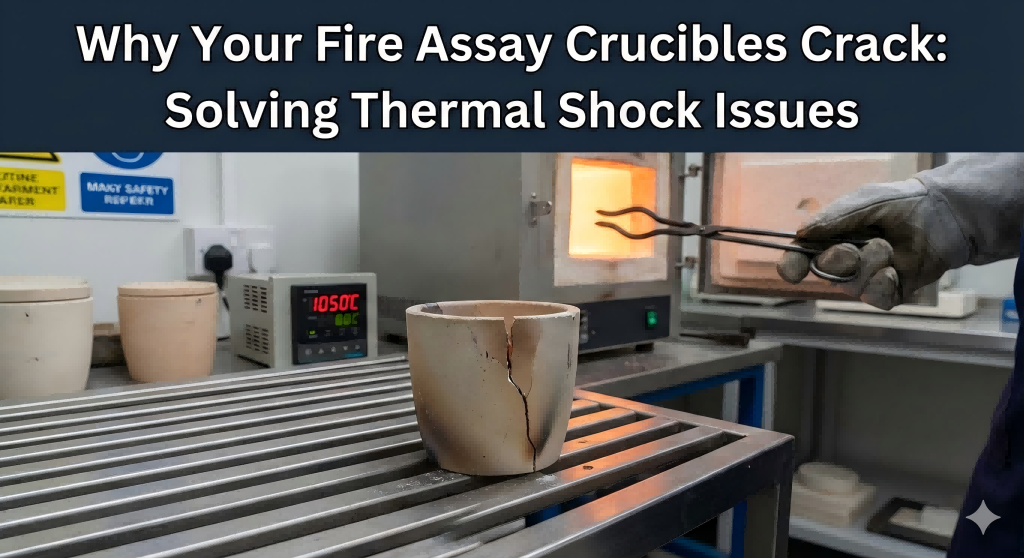
Crucible thermal shock occurs when a ceramic experiences rapid temperature change, creating internal stress that exceeds its tensile strength. Although clay crucibles and other fire assay ceramics are refractory (designed for high temperatures), they remain brittle materials.
Thermal shock typically results from:
- Rapid heating in fusion furnaces
- Sudden cooling after pouring
- Uneven temperature distribution across the crucible wall
When the exterior of a crucible heats or cools faster than the interior, differential expansion causes cracking. Because fire assay ceramic cannot plastically deform, stress is released through fracture.
Key takeaway: Even premium refractory materials will crack if exposed to excessive thermal gradients.
Why Fire Assay Crucibles Are Especially Vulnerable
Fire assay subjects crucibles to extreme and repeated thermal cycling, often above 1,000 °C. Several common practices increase failure risk:
High Heating Rates
Loading room-temperature crucibles directly into a hot furnace creates severe temperature gradients.
Multiple Firings
Repeated use weakens the ceramic microstructure over time, as micro-cracks form and eventually propagate into fractures.
Flux–Ceramic Interaction
Aggressive fluxes penetrate porous clay crucibles, weakening the ceramic matrix and accelerating failure.
Environmental Shocks
These include “Cold Charge” shock (dropping room-temperature samples into a 1,000°C crucible), direct contact with cold steel cooling benches, or rapid cycling without proper tempering.
Common Shock Scenarios
- Adding a cold charge into a hot crucible
- Placing a white-hot crucible on a cold steel surface
- Rapid movement between furnace, pouring, and cooling stations
Common Fire Assay Ceramic Materials
| Material Type | Thermal Shock Resistance | Notes |
|---|---|---|
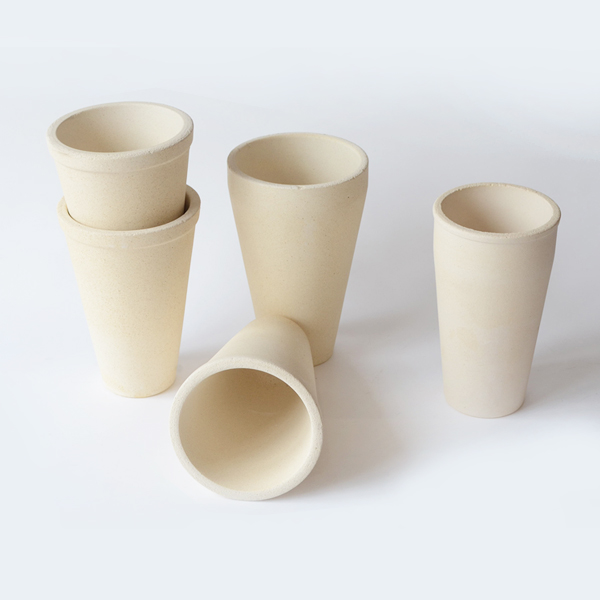
| Clay crucibles | Moderate | Cost-effective but sensitive to rapid heating |
| Alumina-based ceramics | High | Strong, chemically resistant, longer service life |
| Cordierite ceramics | Very high | Low thermal expansion, excellent shock resistance |
Compared with engineered formulations, traditional clay crucibles generally have higher thermal expansion and lower durability under multiple firings.
How Multiple Firings Accelerate Crucible Failure
Each firing cycle causes microstructural fatigue within the ceramic:
- Repeated expansion and contraction generate internal stress
- Flux residues alter pore structure
- Grain boundaries weaken over time
Eventually, cracking becomes unavoidable – even with careful handling. For this reason, crucible life should be measured not only by appearance, but also by number of firings completed.
Best practice: Track crucible usage and retire units before catastrophic failure occurs during fusion.
Practical Ways to Prevent Crucible Thermal Shock
In high-volume labs, extending crucible life directly reduces operating costs. The following practices help maximize the performance of fire assay ceramic products.
1. Preheat Crucibles Gradually
Never place a cold crucible into a hot furnace. Stage crucibles on top of the furnace or in a drying oven (150–200 °C) before fusion to stabilize the ceramic and reduce thermal gradients.
2. Match Crucible Type to Application
High-litharge or aggressive fluxes erode crucible walls, increasing crack risk. For demanding conditions, select higher-grade refractory materials designed for chemical resistance and repeated firings.
3. Control Cooling Rates
Thermal shock also occurs during cooling. Avoid placing hot crucibles on cold metal or in drafts. Use insulated racks or controlled cooling areas to allow gradual temperature reduction.
4. Eliminate Moisture
Even trace moisture in clay crucibles can cause explosive cracking during heating. Store crucibles in dry, temperature-stable environments.
When Cracking Indicates a Specification Problem
If crucibles crack consistently despite proper handling, the issue may be material specification, not operator technique. The performance of fire assay ceramic depends on its formulation—specifically the balance of clay, alumina, and silica.
High-quality refractory materials feature:
- High alumina content for strength and chemical resistance
- Controlled porosity to absorb thermal stress
- Low thermal expansion to improve shock resistance
In commercial fire assay labs, upgrading to engineered ceramics often results in:
- Longer crucible lifespan
- More consistent assay results
- Lower cost per assay over time
Final Thoughts: Fire Assay Ceramic Performance Is a Material + Process Equation
Cracked crucibles are not an unavoidable expense. They are usually a symptom of poor thermal management or inappropriate ceramic selection. By understanding how fire assay ceramic responds to heat, flux chemistry, and multiple firings, laboratories can dramatically reduce failure rates.
Choosing low-grade crucibles may reduce purchase cost, but it increases downtime, waste, and assay risk. In professional fire assay operations, quality refractory materials are an investment – not a luxury.
Looking to reduce crucible cracking and extend service life in your fire assay lab?
Runtao Ceramic specializes in high-performance fire assay ceramic crucibles engineered for thermal shock resistance, chemical stability, and consistent results across multiple firings.
👉 Contact Runtao Ceramic today to discuss your assay conditions and select the right refractory solution for your laboratory.